Mumbai / New Delhi, Sep 18: Varun Dagar, a 22-year-old IT professional from Noida, has regained functional vision after undergoing a specialised corneal procedure at Dr Agarwals Eye Hospital, Preet Vihar. Varun was diagnosed with advanced keratoconus in both eyes, a condition that causes the cornea to become thin and irregular, severely affecting vision. Since glasses could no longer adequately correct his vision, he underwent Corneal Allogenic Intrastromal Ring Segments surgery along with Corneal Collagen Cross-Linking on his left eye. The procedure, performed by Dr Saumya Sharma, Senior Ophthalmologist, Dr Agarwals Eye Hospital, Preet Vihar, helped restore functional vision within 24 hours.
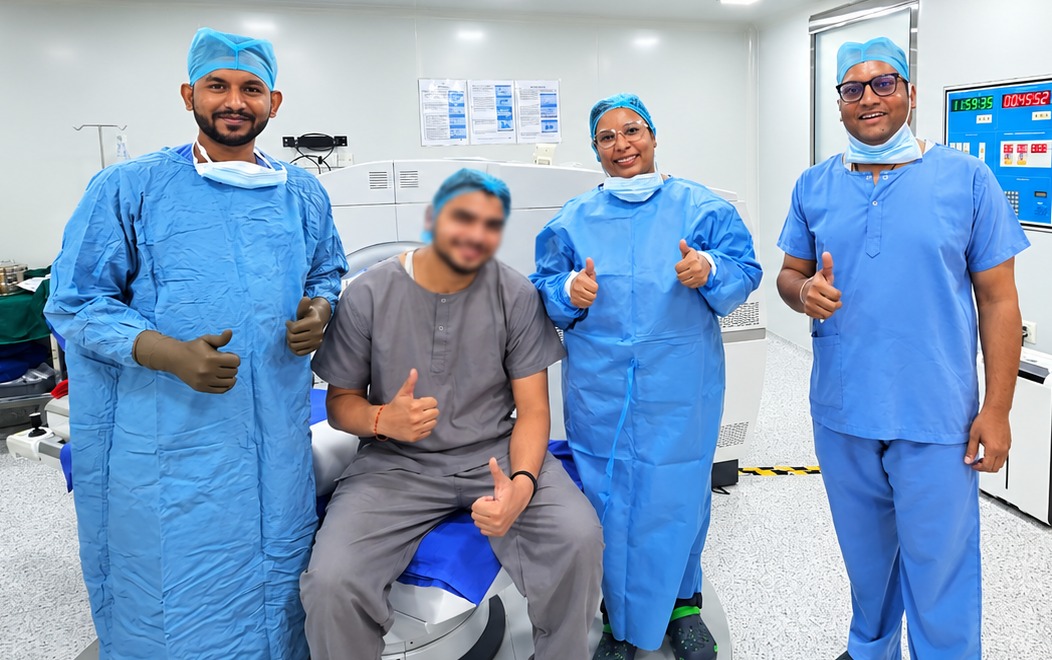
For Varun, his vision had been deteriorating for years. He had advanced keratoconus, in which the cornea gradually becomes thinner and bulges outward, causing blurred and distorted vision. He experienced persistent blurring, frequent changes in his glasses prescription, and increasing sensitivity to light and glare. Everyday activities such as working on a computer, reading, and recognising faces from a distance had become increasingly difficult. By the time he sought treatment, his unaided vision in the left eye had fallen to 3/60 and could be corrected only to 6/36 even with glasses, significantly affecting his ability to see clearly.
Varun first consulted an ophthalmologist in Haryana, where he was diagnosed with keratoconus. However, the treatment he required was not available locally, and he was advised to seek advanced care in Delhi. He eventually made his way to Dr Agarwals Eye Hospital, Preet Vihar, where he came under the care of Dr Saumya Sharma.
Dr Saumya Sharma, Senior Ophthalmologist, Dr Agarwals Eye Hospital, Preet Vihar, who performed the surgery, explained,
“Keratoconus in a young patient like Varun needs to be addressed promptly, as the cornea can continue to weaken and vision can deteriorate over time. In advanced cases like his, we may recommend CAIRS along with C3R. CAIRS involves placing small rings segments made from donor corneal tissue to help flatten its cone-like shape, regularize the cornea and improves the way light is focused. C3R is performed alongside it to strengthen the cornea and prevent further progression of the condition. In Varun’s case, we saw a significant improvement within 24 hours. His unaided vision improved from 3/60 before surgery to 6/24 the next day and reached 6/9 with a pinhole. For a young patient who was struggling significantly with his vision, seeing this level of improvement so soon after the procedure was very encouraging.”
CAIRS is among the landmark surgical innovations developed by clinicians at Dr Agarwals Eye Hospital and pioneered by Dr Amar Agarwal, Chairman of Dr Agarwals Eye Hospital. Keratoconus affects approximately 1 in 2,000 people globally, with studies suggesting a higher incidence in India. The condition often runs in families and can also be triggered or worsened by habitual vigorous eye rubbing, particularly in individuals with chronic allergic eye conditions. It most commonly presents in young adults, making early diagnosis and timely treatment critical to preserving long-term vision.
Dr Soosan Jacob, Director & Chief – Refractive and Cornea Foundation (DARCF), Dr Agarwals Eye Hospital, added,
“CAIRS is one of the most valuable additions to our surgical armamentarium for keratoconus, offering patients like Varun a way to regain functional vision while preserving their own cornea rather than requiring a transplant. At the Refractive and Cornea Foundation, we have seen how a technically demanding procedure like this, when combined with C3R, can meaningfully change outcomes for young patients whose vision has been steadily deteriorating over time. Keratoconus is increasingly being diagnosed in young adults across India, which makes early detection and timely access to advanced treatment options genuinely critical for preserving long-term vision. Introducing CAIRS in East Delhi is an important step in that direction, allowing more patients in the region to receive specialised corneal care closer to home, without needing the added burden of travelling to other cities for treatment.”
Performing CAIRS requires considerable surgical precision. The procedure involves creating a precise channel within the cornea using a femtosecond laser and carefully inserting the donor corneal segment. The technique requires specialised training and surgical expertise and is performed by a limited number of surgeons. In Varun’s case, the surgery on his left eye was completed in approximately 60 minutes. Dr Sharma also ensured close postoperative care and support, which is particularly important for a young patient undergoing treatment for a progressive condition such as keratoconus.
The results have been encouraging. The day after surgery, Varun’s unaided vision in the left eye improved from 3/60 to 6/24 and to 6/9 with a pinhole, allowing him to work on a computer, read, and recognise faces more clearly. He returned to his office within a week of the procedure. During the healing period, Varun has been given postoperative instructions and advised to use his prescribed eye drops for a period of 3 months.
“I had been struggling with my vision for a long time and kept changing my glasses, but nothing seemed to help. I was nervous when I first heard about the surgery, but Dr Sharma explained everything to me clearly and made me feel comfortable. The morning after the surgery, I can see much better now than I could before my surgery, and I honestly couldn’t believe it. I’m very happy that I came to Dr Agarwals Eye Hospital,” said Varun Dagar, patient.