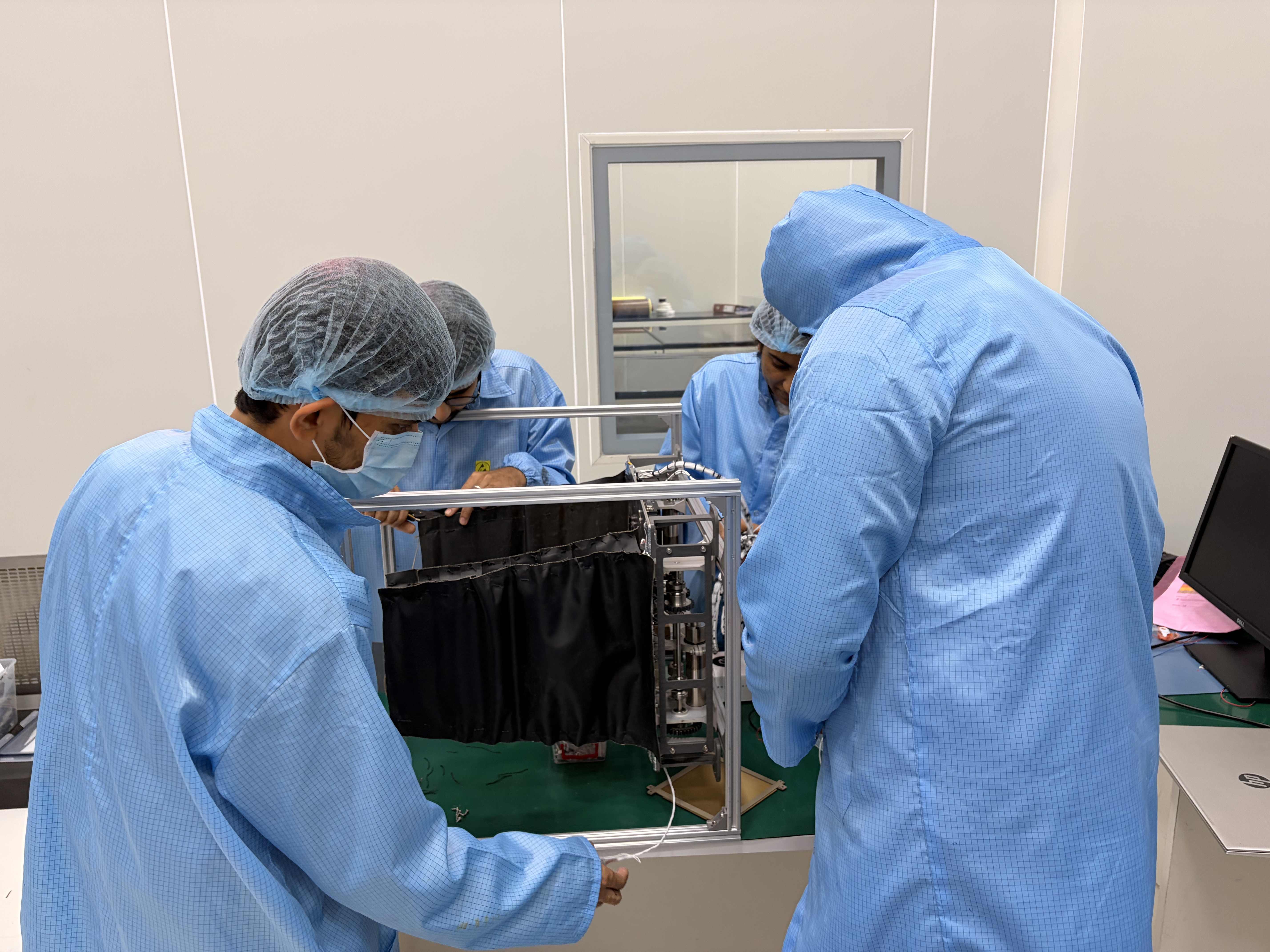
Hyderabad, India, July 06: Cosmoserve Space, an Indian startup developing Active Debris Removal (ADR) technologies, today announced Mission Embrace, its first orbital technology demonstration, which will fly aboard Skyroot Aerospace’s Vikram-1 maiden orbital launch, Mission Aagaman, during the approved launch window between July 12 and August 4, 2026. Mission Embrace will fly aboard India’s first privately developed orbital launch vehicle carrying satellite payloads, while simultaneously attempting the world’s first demonstration of soft robotic capture in orbit.
Cosmoserve Space is building solutions to one of spaceflight’s most pressing challenges: the growing population of dead and derelict satellites cluttering Earth orbit. With thousands of inactive satellites and debris objects currently orbiting Earth, and many more expected as satellite constellations continue to expand, Active Debris Removal (ADR) is emerging as one of the most critical capabilities for ensuring long-term orbital sustainability. The company’s core offering is a dual-spacecraft system, in which a robotic servicer spacecraft is capable of capturing and removing defunct satellites at roughly one-tenth the cost of any comparable solution available today.
At the heart of that system is Cosmoserve‘s soft robotic capture mechanism, a compliant capture technology purpose-built to gently latch onto unprepared and non-cooperative objects in orbit — precisely the conditions found around dead satellites. Mission Embrace will validate this capture technology in the space environment for the first time anywhere in the world, a milestone the company considers foundational to its broader debris-removal roadmap.
The pace of development behind Mission Embrace is itself notable: the soft robotic capture technology was advanced from initial concept to flight-ready hardware in just four months. Cosmoserve Space was incorporated less than a year ago and having a payload already on the launch pad places it among the fastest companies in the world to progress from founding to flight. From initial concept to flight-qualified hardware in just four months, Mission Embrace demonstrates how India’s emerging private space ecosystem is dramatically shortening technology development cycles while delivering globally relevant innovation.
Development followed a structured engineering and review process overseen by an independent committee comprising former ISRO scientists and industry veterans. The technology was formally assessed at each major milestone — system concept review (SCR), preliminary design review (PDR), critical design review (CDR), and flight readiness review (FRR) — before being cleared for flight.
Dr. Chiranjeevi Phanindra, Founder & Chief Executive Officer, Cosmoserve Space, said, “Mission Embrace forms part of India’s first private orbital launch carrying satellite payloads while also attempting the world’s first demonstration of soft robotic capture in orbit. We developed this technology from concept to flight-ready hardware in just four months within a company that is less than a year old, without compromising engineering rigor. Through this mission with Skyroot, we are demonstrating how rapidly India’s private space ecosystem can innovate through collaboration. Mission Embrace is an important milestone in advancing technologies that will enable orbital sustainability and space debris removal.”
Mission Embrace represents the first milestone in Cosmoserve Space‘s long-term vision to build scalable technologies for Active Debris Removal (ADR) and in–orbit servicing. As satellite constellations continue to expand and orbital congestion increases, technologies that enable capture, and removal of defunct spacecraft will become essential to the future of space operations. With Mission Embrace, Cosmoserve Space takes its first step towards building critical orbital infrastructure that will help create a safer, more sustainable, and commercially viable space ecosystem.