Environment Minister stresses innovation, scientific forest management and ecological security as India works towards Viksit Bharat@2047
New Delhi: Union Environment, Forest and Climate Change Minister Bhupender Yadav has urged Indian Forest Service (IFS) officers to strengthen conservation efforts through scientific decision-making, technological innovation and greater community participation. He emphasised that protecting India’s natural ecosystems must remain an integral part of the country’s long-term economic development strategy.
The Minister shared his views during an interaction with officers participating in the Mid-Career Training (MCT) Phase-III (19) programme of the Indian Forest Service in New Delhi. The discussion focused on India’s conservation priorities, the challenges confronting forest administrators and the need to strengthen institutional capabilities to address emerging environmental concerns.
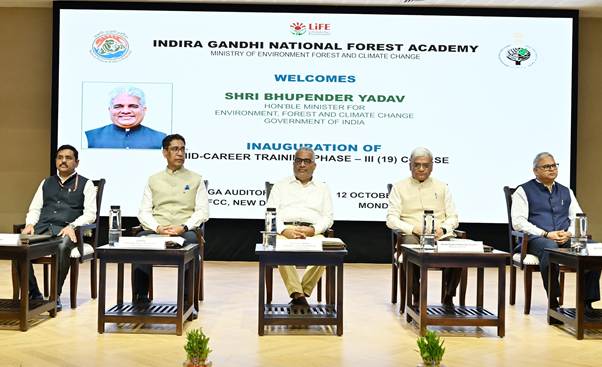
Senior officials attending the interaction included Narendra Bhooshan, Secretary of the Ministry of Environment, Forest and Climate Change (MoEFCC); Santosh Tiwari, Director General of Forests and Special Secretary; Ramesh Pandey, Additional Director General of Wildlife; and Rajendra Prasad Khajuria, Director of the Indira Gandhi National Forest Academy (IGNFA), along with other ministry officials.
Recognising the contribution of forest officers to protecting India’s ecological wealth, Yadav highlighted progress in wildlife conservation, forest and tree cover, carbon sequestration, wetland protection and landscape restoration.
He also drew attention to initiatives designed to combine environmental restoration with public participation. These include Ek Ped Maa Ke Naam, MISHTI, the Aravalli Green Wall Project and Nagar Van Yojana, which support tree planting, ecosystem improvement and the creation or restoration of green spaces.
The Minister stressed that the national objective of Viksit Bharat@2047 must be pursued alongside the protection of forests, wildlife and biodiversity. Integrating ecological considerations into development planning, he indicated, is essential to maintaining a balance between economic aspirations and environmental responsibilities.
The growing complexity of forest management requires officers to address challenges extending beyond conventional conservation activities. Yadav identified human-wildlife conflict, forest fires and climate change as major concerns requiring timely interventions and evidence-based solutions.
He underlined the importance of understanding local ecosystems and adapting management strategies to the diverse climatic and geographical conditions found across India.
Community participation was another key theme of the interaction. Working closely with local populations and drawing on traditional knowledge can help forest administrators develop practical responses to conservation challenges while encouraging wider public involvement in protecting natural resources.
The Minister encouraged the participating officers to approach field-level problems with fresh perspectives and devise solutions that reflect local realities.
GIS, Remote Sensing and AI Gain Importance in Forest Administration
As environmental pressures intensify, technology is creating new opportunities to improve forest monitoring, conservation planning and administrative efficiency.
Yadav highlighted the potential of Geographic Information Systems (GIS), remote sensing and artificial intelligence (AI) to support forest management and more informed decision-making. Such tools can help administrators assess landscapes, monitor environmental changes and strengthen the preparation and implementation of forest management plans.
He urged officers to develop the technical understanding needed to incorporate these capabilities into their work. At the same time, he emphasised that technological adoption must be supported by continuous capacity building, institutional strengthening and effective implementation at the field level.
The Minister called for a broader approach to forest administration, encouraging officers to move beyond traditional regulatory responsibilities and take on greater roles as innovators, institutional leaders and facilitators of sustainable development.
He highlighted the value of combining field experience with exposure to policy formulation at the ministry level. According to the Minister, this cross-functional understanding can help officers connect conservation priorities with wider governance and development objectives.
The emphasis on professional development also reflects the need for forest administrators to respond to emerging challenges with a combination of scientific expertise, administrative experience and an understanding of community needs.
The interaction reinforced the importance of strengthening India’s forest governance framework at a time when climate change, biodiversity protection and competing demands on land and natural resources are becoming increasingly significant.
For the Indian Forest Service, the challenge lies in translating conservation objectives into effective action through better planning, modern technology, stronger institutions and sustained public engagement.
Yadav’s message to the officers centred on the need to adopt innovative approaches while maintaining a clear focus on safeguarding the country’s ecological heritage. As India advances towards its 2047 development vision, the effectiveness of forest management and conservation programmes will remain an important component of its broader sustainability agenda.