– by Anil Pharande, Founder & Chairman – Pharande Spaces
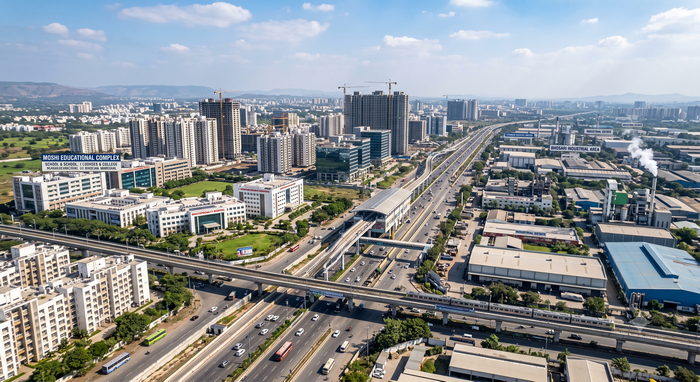
Moshi, Bhosari and the Moshi Pradhikaran area occupy the eastern edge of Pune, along the Pune–Nashik highway and the contiguous industrial belt of Bhosari. Until recently, this corridor was regarded primarily as an industrial and peripheral zone. Over the last decade, however, it has begun to function as an emerging urban sub-hub, supported by a combination of institutional, civic and large-scale infrastructure projects.
Price Growth Trends
Property prices in the Moshi–Bhosari corridor have moved from a low-base, slow-growth phase to a more sustained appreciation trajectory. In Moshi, average residential rates in 2025–26 were in the range of INR 4,700/sq.ft. to INR 7,200/sq.ft., with a five-year capital appreciation of approximately 17.5%. This reflects a steady, multi-year upward trend rather than a speculative spike.
Bhosari, in the same period, shows a price range of roughly INR 5,000/sq.ft. to INR 6,200/sq.ft. for residential properties. The area has appreciated at a rate comparable to the broader Pimpri–Chinchwad corridor, which has seen around 17% cumulative growth over five years. The fact that Bhosari is now tracking this price band shows that the micro-market has moved beyond its earlier peripheral status.
Across the wider Pimpri–Chinchwad belt, records indicate an average appreciation of 17% over five years, with older micro-markets showing more moderate gains and newly emerging nodes demonstrating higher growth. Moshi and parts of Bhosari appear to be positioned within this higher-growth segment, given their infrastructure-led re-rating.
IIM-Nagpur Campus – The Education Anchor
The state government has approved 70 acres of gairan land at Moshi for a Pune campus of IIM-Nagpur. This decision introduces a high-prestige educational anchor into the area. Institutional campuses of this nature typically generate sustained demand for housing, retail, hospitality and support services, and they also improve the perceived quality of the location.
In comparable cases across India, the announcement and construction of a new IIM or similar elite institution have been associated with 10–20% price appreciation in the immediate vicinity within three to five years. In Moshi, the long-term effect is likely to be the emergence of a mixed-use education node, with residential pockets orientated towards faculty housing, student accommodation and related services.
PIECC – The Exhibition-driven Multiplier
The Pune International Exhibition and Convention Centre (PIECC) is already operational. Its open exhibition area hosts 12 to 15 exhibitions annually, and the master plan includes constructed exhibition halls and a 5,000-seater convention centre. Exhibition and convention complexes function as demand agglomerators, creating footfall for hospitality, retail, logistics and event-related businesses.
Historically, areas within 2–4 km of established exhibition nodes have seen 12–18% appreciation over five to seven years, provided that road connectivity and public services are adequate. In Moshi, the PIECC project is expected to generate both direct commercial demand and indirect residential uplift, as professionals employed in the hospitality and event sectors seek housing nearby.
Engineering Colleges, Judicial Infrastructure & 650-bed Hospital
The broader development proposal for the Bhosari–Moshi constituency also includes an engineering college, a judicial complex and a 650-bed hospital. Engineering colleges bring a steady stream of students and academic staff, supporting rental housing and small businesses. Judicial complexes attract lawyers, clerks and administrative personnel, who often prefer to live close to the workplace.
Large hospitals, in turn, create thousands of jobs across clinical and non-clinical functions, generating consistent demand for residential and retail space.
In similar contexts within Pune and other Maharashtra cities, the establishment of a multi-speciality hospital or a legal complex has been associated with 10–15% appreciation in nearby residential markets over three to five years. If these projects materialise in Moshi, the area could see a comparable range of uplift, particularly in the node immediately surrounding the proposed institutions.
Tata Motors – Industrial Power Anchor
Bhosari has long been an established industrial hub, with chemical plants, auto component manufacturers and warehousing facilities. The Tata Motors plant near Moshi serves as a prominent employment anchor, providing thousands of jobs and supporting a large indirect workforce.
Industrial anchors typically generate stable, long-term demand for housing, schools, clinics and retail, reducing the volatility often seen in purely speculative markets.
Experience from industrial belts such as Chakan, Kalamboli and parts of Greater Noida suggests that areas within 3–5 km of large anchor plants often realise 15–20% appreciation over five years, particularly when supported by improved road infrastructure.
The Spine Road and the proposed Charholi link are expected to strengthen this dynamic, making the Moshi–Bhosari corridor more accessible for daily commuters and reducing the stigma historically associated with industrial zones.
Infrastructure-led Price Growth
The cumulative impact of these projects can be understood through the concept of infrastructure-led re-rating. Better connectivity, institutional presence and civic amenities reduce the effective distance of a location from employment and activity centres, thereby increasing its attractiveness to both home buyers and investors.
Based on observed patterns in similar corridors, the following rough ranges of future appreciation may be expected over a five-year horizon, assuming timely implementation:
- Moshi – This market can see an additional 15–20% appreciation over the next five years, following a 17.5% increase due to IIM infrastructure, PIECC-related activity, educational institutions, and a large hospital.
- Bhosari – Starting from a price range of INR 5,000/sq. ft to INR 6,200/sq. ft, industrial expansion, improved road networks and spill-over demand from Moshi’s institutional projects could support 12–18% appreciation over five years.
- Moshi Pradhikaran Node – This area, positioned near the proposed IIM campus and PIECC, has the potential to emerge as a premium mixed-use node. If the planned institutions and infrastructure are delivered as envisaged, 18–25% appreciation over five to seven years is a plausible range.
(The above projections are indicative ranges based on developments in Pune and other Indian cities.)
A Corridor in Structural Transition
The Moshi–Bhosari corridor is transforming into an integrated urban market in its own right. The presence of industrial giants, educational infrastructure, the ongoing expansion of PIECC, and planned civic institutions collectively create a multi-anchor growth model. Road infrastructure upgrades, including the Spine Road and the upgraded Pune–Nashik highway, further enhance connectivity and reduce commute friction.
The price data and growth trends observed in Moshi and Bhosari suggest that the area is already undergoing a structural re-rating. If implemented continuously, the planned projects will establish the eastern edge of Pune as a key growth corridor, blending industry, education, events, and residential development.
The Moshi–Bhosari corridor is already transforming into an integrated urban market in its own right. The presence of industrial giants, educational infrastructure, the ongoing expansion of PIECC, and planned civic institutions collectively create a multi-anchor growth model. Road infrastructure upgrades, including the Spine Road and the upgraded Pune–Nashik highway, further enhance connectivity and reduce commute friction.
The price data and growth trends observed in Moshi and Bhosari show that the area is already undergoing a structural re-rating. With consistent implementation of the planned projects, the eastern edge of Pune will emerge as a key growth corridor – blending industry, education, events, and residential development into an unbeatable investment magnet.
About the author:

Anil Pharande is Chairman of Pharande Spaces, a leading real estate construc