
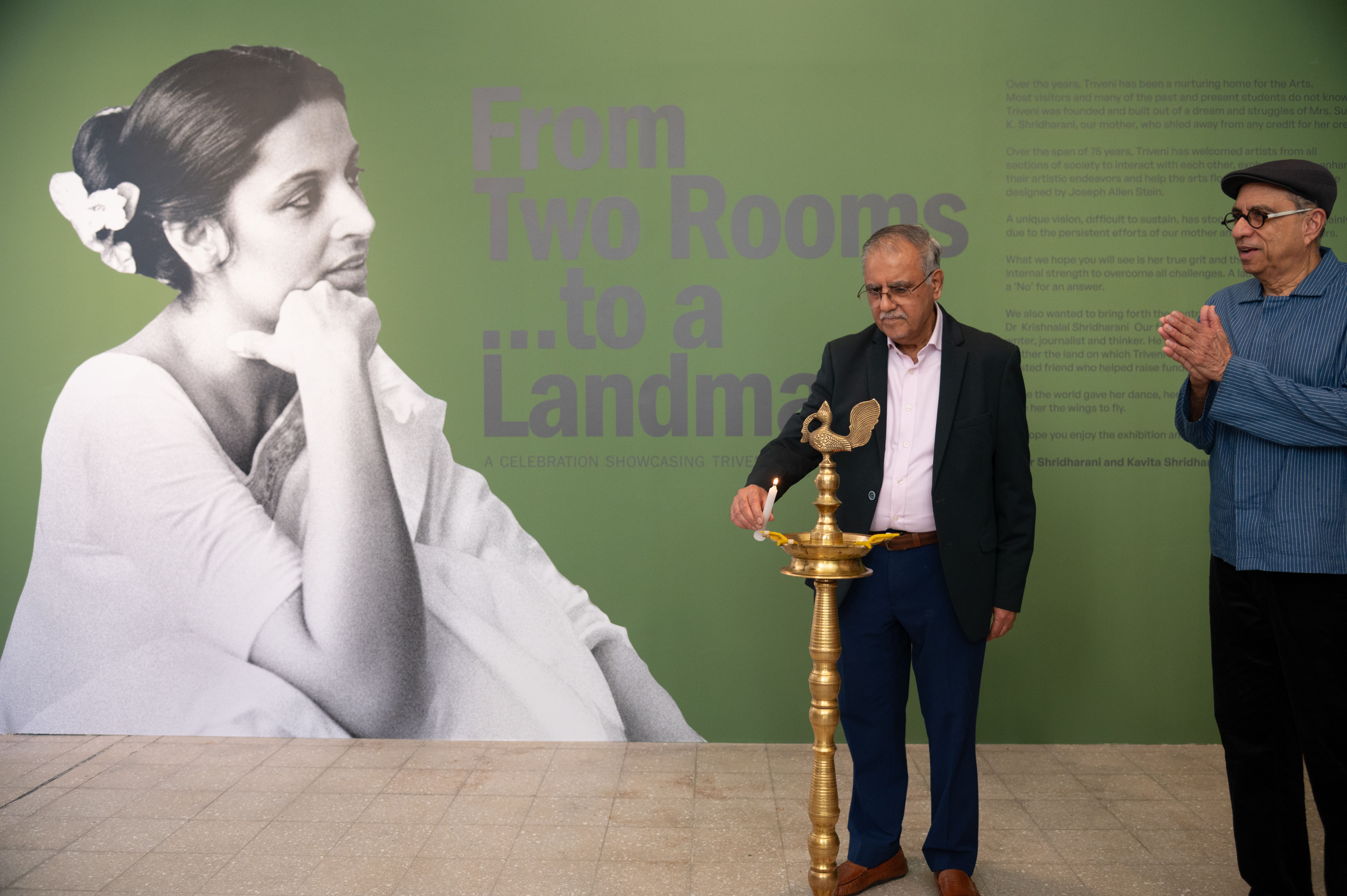
New Delhi, Feb 28: Triveni’s journey began in two rented rooms in Connaught Place and culminated in the iconic landmark building at Mandi House. The country’s treasured epicentre of the arts, Triveni Kala Sangam, today inaugurated its landmark 75th anniversary festival, celebrating seven and a half decades of artistic excellence, education and cultural openness in the heart of Delhi. Since its inception in 1950, the institution, built almost single-handedly by Late Smt. Sundari K. Shridharani through sheer grit and perseverance, has nurtured generations of artists, performers and teachers across disciplines, supporting over ten thousand individuals with platforms, audiences and students, and contributing significantly to India’s modern artistic landscape.
Running from 27 February to 15 March 2026, the commemorative festival is anchored by the exhibition From Two Rooms… to a Landmark, presenting rare photographs, documents and narratives from Triveni’s founding decades and its evolution within Delhi’s post-Independence cultural milieu. The wider programme features performances by eminent practitioners, artist interactions, craft showcases and public events reaffirming Triveni’s long-standing commitment to emerging artists and cross-disciplinary exchange. Highlights include the theatre conversation The Importance of Being Triveni, featuring renowned director and educator Feisal Alkazi in dialogue with journalist Mandira Nayar, and Working with Stein – The Inside Story, where architects Sudhish Mohindroo and Meena Mani will revisit their formative years with the legendary Joseph Allen Stein and reflect on the making of landmark cultural institutions including the Triveni campus.
Another feature is the revival of Triveni’s historic café legacy through a limited Heritage Menu (23 February-15 March), recalling the Tea Terrace of the 1960s, when artists, writers and students shared tables with modern masters such as M. F. Husain, Krishen Khanna, Vivan Sundaram, Raghu Rai and Tyeb Mehta; dancers including Hema Malini, Indrani Rahman, Birju Maharaj, Narendra Sharma and Yamini Krishnamurthy; musicians such as sitar maestro Ravi Shankar and his disciple Pt. Uma Shankar Mishra, Pt. Jasraj, Pt. Amarnath and Pt. Hari Prasad Chaurasia; and theatre figures from the National School of Drama including Ebrahim Alkazi, Sheela Bhatia, Anuradha Kapoor, Om Shiv Puri, Om Puri, Habib Tanveer and Naseeruddin Shah, shaping India’s modern cultural imagination in an open, democratic space for dialogue and practice.
Inaugurating the anniversary programme, Amar Shridharani, Honorary General Secretary, Triveni Kala Sangam, said, “Seventy-five years is evidence of continuity. Triveni Kala Sangam was conceived as a complete cultural ecosystem where disciplines meet and influence one another. Over these decades, the institution has nurtured and supported more than 10,000 artists, teachers and cultural professionals across disciplines. As we look to the next 25 years, our commitment remains the same: to sustain artistic freedom, keeping teaching at its core and preserving the classical forms of Indian dance and music, while expanding access through new technologies, digital archives and a renewed focus on interdisciplinary collaborations that carry this vision forward for future generations.”
The festival honours the visionary legacy of founder Late Smt. Sundari K. Shridharani, whose journey began with a young girl’s passion for rhythm in Karachi and grew into the vision of creating an open interdisciplinary space where visual arts, music, dance and theatre could coexist freely. In 1960, this vision found architectural expression in the modernist campus designed by Joseph Allen Stein, whose open courtyards and human-scale galleries continue to shape Triveni’s distinctive experience of art as part of everyday life.
Across 75 years, Triveni Kala Sangam has remained unique in its firm refusal of ticketing, private donations and commercialisation, principles sustained through decades of political, economic and cultural change in the Indian capital. Conceived as an open cultural campus rather than an exclusive venue, it has functioned as a democratic public space where emerging and established artists and audiences share the same courtyards, galleries and performances without hierarchy or barrier. This continuity of vision, offering access without privilege and art free from commodification, has shaped India’s modern artistic landscape while allowing Triveni to endure as one of Delhi’s rare living cultural commons. Over the decades, this open platform has welcomed and been enriched by eminent masters, including Odissi legend Guru Kelucharan Mohapatra, dancer and choreographer Uday Shankar, maestros Yamini Krishnamurthy and Indrani Rahman, and theatre visionaries Habib Tanvir and Ebrahim Alkazi, reflecting its enduring role as a meeting ground of India’s leading artistic traditions. As it enters its next quarter century, Triveni continues to evolve while remaining rooted in its founding values of accessibility, artistic independence and shared cultural space.
The Triveni@75 festival is open to the public from 27 February to 15 March 2026 at Triveni Kala Sangam, New Delhi.